

Cara Memastikan Konsistensi Warna pada Permukaan yang Dilapisi Galvanis dan PVD

Di pasar produk premium saat ini, penampilan memainkan peran penting dalam persepsi kualitas. Lengkungan elegan keran mewah, hasil akhir yang halus pada pegangan peralatan rumah tangga, atau nuansa canggih dari perangkat keras arsitektur dapat sangat memengaruhi keputusan pembelian. Permukaan berlapis galvanik dan berlapis PVD umumnya digunakan untuk menciptakan hasil akhir kelas atas yang tampak konsisten dari satu bagian ke bagian lain dan dari satu batch ke batch lainnya. Namun, mencapai warna yang stabil dan mempertahankan penampilan jangka panjang di seluruh lot produksi dan lingkungan dunia nyata bukanlah hal yang mudah. Dengan toleransi yang semakin ketat dan rantai pasokan global yang semakin luas, pengukuran warna objektif menjadi sangat penting untuk menjaga kualitas produk, meminimalkan pengerjaan ulang, dan memastikan konsistensi merek.
Pelapisan galvanik, juga dikenal sebagai elektroplating, menggunakan proses elektrokimia untuk melapisi lapisan tipis pada substrat. Proses ini banyak dipilih untuk meningkatkan ketahanan korosi, mendukung kinerja keausan, dan menghasilkan lapisan dekoratif dalam berbagai macam warna. Warna yang dihasilkan dipengaruhi oleh beberapa variabel, termasuk persiapan substrat, ketebalan lapisan, komposisi kimia larutan, metode pemolesan, dan proses pasca-perlakuan. Bahkan perubahan kecil dalam proses dapat menyebabkan perubahan kecerahan, corak, atau kilap, sehingga terlihat jelas pada produk premium, terutama ketika komponen ditampilkan di bawah pencahayaan yang berbeda.
Deposisi uap fisik (PVD) adalah proses berbasis vakum di mana bahan pelapis diuapkan dan diendapkan sebagai lapisan tipis pada permukaan. Pelapis PVD dihargai karena daya tahannya dan kemampuannya untuk menciptakan berbagai macam hasil akhir dekoratif, dari warna sampanye hangat hingga permukaan hitam pekat. Untuk hasil akhir di mana penampilan sensitif terhadap ketebalan lapisan tipis, variasi kecil dapat mengubah warna yang terlihat, sehingga kontrol proses yang ketat dan memiliki metode verifikasi yang andal sangat penting.
Memahami Tantangan Pengukuran Permukaan Berlapis Galvanik dan Berlapis PVD
Permukaan berlapis galvanik dan berlapis PVD sering dirancang untuk mencapai mengkilap atau lapisan akhir yang memantulkan cahaya. Penampilannya dapat berubah karena sudut pandang, pencahayaan, dan warna di sekitarnya. Keran yang terlihat seragam di area inspeksi pabrik mungkin terlihat sedikit berbeda di bawah lampu sorot ruang pamer atau cahaya alami. Penilaian visual Inspeksi visual juga bersifat subjektif dan dapat dipengaruhi oleh faktor-faktor seperti kelelahan, pencahayaan yang tidak konsisten, atau persepsi warna individu. Mengandalkan inspeksi visual saja dapat menyebabkan keputusan yang tidak konsisten dan perselisihan yang dapat dihindari antara produsen dan pemasok.
Pengukuran warna objektif mengurangi ketidakpastian ini. Spektrofotometer mengukur reflektansi spektral dan menghitung nilai kolorimetri dalam ruang warna standar seperti CIE L*a*b*. Kemudian, produsen mengukur perbedaan menggunakan ΔE (Delta E) yang memberikan metode yang jelas dan dapat diulang untuk membandingkan sampel produksi dengan standar yang disetujui. Dengan toleransi yang ditentukan. Dengan demikian, pengendalian mutu menjadi berbasis data dan dapat diterapkan secara konsisten di seluruh fasilitas dan wilayah.
Memastikan Konsistensi pada Bentuk Kompleks dan Setelah Terpapar Lingkungan
Aplikasi tertentu menimbulkan tantangan pengukuran tambahan. Bagian melengkung pada keran mewah dan pegangan peralatan rumah tangga adalah contoh utamanya. Geometrinya membuat penempatan yang stabil lebih sulit daripada pada panel datar, dan permukaan reflektif dapat menimbulkan variasi pengukuran jika penempatan tidak konsisten. Karena bagian-bagian ini sangat terlihat dan sering disentuh, bahkan ketidakkonsistenan yang halus pun dapat memengaruhi persepsi kualitas produk. Pengukuran yang andal membutuhkan pendekatan yang mendukung penempatan yang berulang dan kondisi pengukuran yang terkontrol pada area melengkung.
Evaluasi daya tahan sama pentingnya. Keran, gagang, dan perangkat keras arsitektur terpapar tekanan jangka panjang, termasuk perubahan suhu dan kelembapan, pembersihan rutin, dan paparan cahaya. Banyak produsen juga melakukan uji penuaan dipercepat yang menggabungkan UV, panas, dan kelembapan untuk mengevaluasi stabilitas warna jangka panjang. Mengukur warna sebelum dan sesudah pengujian memungkinkan produsen untuk mengukur pemudaran, perubahan warna, atau penguningan menggunakan ΔE, sehingga mendapatkan keputusan objektif tentang material, pengaturan proses, dan kepatuhan terhadap standar penampilan.
Solusi Pengukuran Warna Konica Minolta untuk Pelapisan Galvanik dan PVD
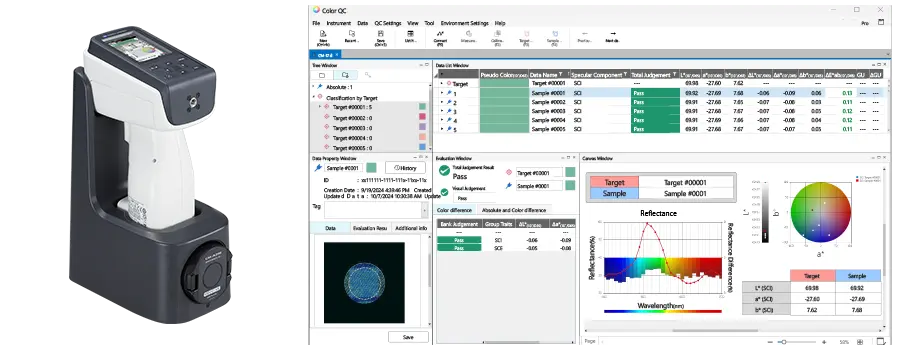
Spektrofotometer CM-17d dan SpectraMagic™ NX2
Konica Minolta menawarkan rangkaian lengkap produk-produknya. Solusi pengukuran warna digunakan di berbagai industri, termasuk lapisan, bahan kimia dan masih banyak lagi. Spektrofotometer dan perangkat lunak manajemen warnanya membantu produsen mengganti inspeksi visual subjektif dengan evaluasi warna objektif berbasis data. Dengan mendukung ruang warna standar dan metrik perbedaan warna ΔE, solusi ini memungkinkan komunikasi warna yang konsisten di seluruh pemasok, lokasi produksi, dan rantai pasokan global.
Untuk aplikasi yang melibatkan komponen kecil atau permukaan melengkung, seperti lengkungan keran mewah dan pegangan peralatan rumah tangga, Spektrofotometer Konica Minolta CM-17d menawarkan solusi pengukuran praktis untuk lingkungan produksi. Bentuk vertikalnya mendukung penempatan yang stabil selama pengukuran, sementara jendela bidik kamera terintegrasi membantu pen positioning yang akurat pada permukaan yang sulit. Fitur-fitur ini membantu meningkatkan konsistensi pengukuran saat bekerja dengan permukaan yang memantulkan cahaya atau melengkung.
CM-17d juga mendukung SCI (Specular Component Included) dan SCE (Specular Component Excluded). Mode pengukuran memungkinkan pengguna untuk mengevaluasi warna “sebenarnya” atau tampilan visual keseluruhan tergantung pada aplikasinya. Selain itu, instrumen pengukuran warna dirancang untuk memberikan pengulangan yang andal dan kuat. Perjanjian Antar Instrumen (IIA), membantu memastikan evaluasi warna yang konsisten ketika standar yang digunakan sama di antara pemasok dan lokasi produksi.
Untuk memperluas kontrol warna di luar instrumen, Konica Minolta SpectraMagic™ NX2 (SMNX2) perangkat lunak ini mendukung standar digital, evaluasi lulus/gagal berbasis toleransi, templat yang dapat disesuaikan, dan alat pelaporan untuk dokumentasi dan pemantauan kualitas. Bersama-sama, CM-17d dan SMNX2 membantu menstandarisasi cara warna diukur, dievaluasi, dan dikomunikasikan di seluruh rantai pasokan.
Unduh whitepaper kami. untuk mempelajari lebih lanjut tentang kontrol kualitas warna tingkat lanjut untuk permukaan berlapis galvanik dan berlapis PVD.
Tertarik mempelajari lebih lanjut tentang CM-17d dan SMNX2? Atau butuh bantuan untuk menemukan solusi pengukuran warna yang tepat untuk aplikasi Anda? Hubungi pakar kami untuk menjadwalkan konsultasi atau demonstrasi gratis.