

Display Waveform Measurement for Display Performance Validation
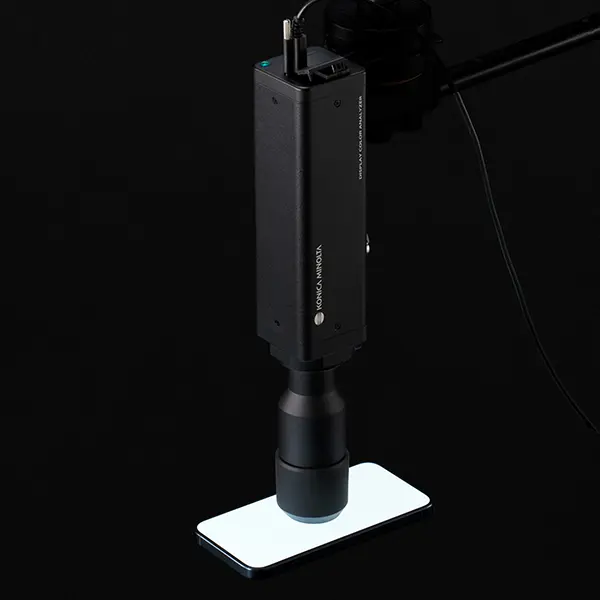
Modern displays such as OLED, MicroLED, and Mini-LED are no longer evaluated solely by static color and luminance values. While those measurements remain essential, they do not fully represent the end-user experience in real-world scenarios. Temporal behavior—how brightness and color change over time due to refresh cycles, frame insertion methods, pulse-width modulation (PWM) dimming, local dimming control, and Variable Refresh Rate (VRR) operation—has become a key factor of perceived quality and visual comfort. This is especially true as displays become more power-efficient and algorithm-driven because a number of techniques used to improve contrast, reduce power consumption, and increase motion smoothness rely on time-dependent driving strategies. As a result, display performance validation must increasingly include time-domain evaluation, not only to meet technical specifications but also to protect user comfort, avoid flicker-related complaints, and improve stability.
What Is Display Waveform Measurement and Why It Matters
A display waveform is a time series of optical output (usually Luminance and/or Chromaticity) captured at a sufficiently high sampling rate to show how a display emits light over time. Rather than describing a display using a single averaged value, waveform measurement reveals the emission profile within a frame, a subframe, or across multiple refresh cycles, making temporal behavior visible and measurable. This matters as some issues that affect perceived quality and user comfort are time-dependent, especially in modern displays that rely on PWM dimming, scanning backlights, frame insertion strategies, local dimming algorithms, or VRR operation. Once temporal emission behavior can be measured, it becomes easier to validate performance, compare operating modes, and identify instabilities that static measurements cannot reveal.
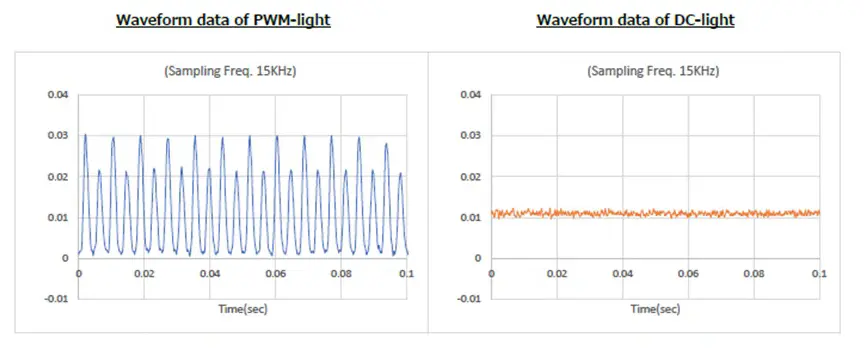
Waveform measurement is widely used because it provides a direct method for detecting and quantifying flicker, whether caused by PWM dimming, frame-rate strobing, backlight scanning, or other modulation strategies that may not be apparent in conventional luminance readings. It also supports evaluation of transition behavior—including rise and fall trends, overshoot, and settling—which can influence motion appearance and perceived brightness stability in fast-changing content. As VRR becomes more common, waveform measurement has become increasingly vital for validating VRR performance, particularly during frequency switching, where emission patterns may change in ways that affect comfort and flicker. Additionally, waveform measurement helps demonstrate compliance with user comfort requirements and product specifications, particularly when verifying flicker limits and stroboscopic artifact thresholds. Because waveform capture provides a clear view of optical emission timing, it can also be used to correlate optical events with electrical driving signals and firmware behavior, supporting root-cause analysis and confirming the effects of driver or algorithm tuning.
Key Metrics From Waveform Analysis
A key advantage of waveform measurement is that it produces time-domain data, enabling users to extract metrics that describe temporal emission quality. One of the most widely used metrics is modulation amplitude, often expressed as peak-to-peak variation or RMS modulation. These values quantify the strength of luminance fluctuation and are commonly used in flicker analysis. Duty cycle and pulse width are also highly informative, especially in PWM-driven systems, because they describe how long the display emits light during each cycle and how this timing relates to the intended brightness setting.
Depending on the stimulus and capture setup, additional temporal metrics such as rise time, fall time, and response latency (relative to a trigger or timing reference) can be derived from the waveform. These metrics support evaluation of how quickly optical emission transitions and stabilizes after changes in brightness or driving conditions. In advanced workflows, the waveform signal may also be analyzed in the frequency domain using FFT-based methods to reveal dominant frequency components and help distinguish PWM-related modulation from refresh-synchronous components and lower-frequency oscillations. Synchronization timing is another critical element of waveform evaluation, as aligning optical events with timing references such as VSYNC helps verify whether emission behavior follows expected refresh boundaries and enables correlation with electrical driving signals or firmware-level changes when diagnosing temporal instability.
How to Interpret Display Waveforms
Once waveforms are captured, interpreting them becomes essential for connecting measurement results to practical optimization. When a waveform exhibits regular periodic pulses at a fixed frequency, it typically indicates PWM-based backlight dimming in backlit display systems. In this case, the measured duty cycle can be compared against the expected brightness setting to confirm whether dimming control is behaving as intended.
When a waveform contains large, short spikes synchronized to the frame edge, it may suggest potential scanning backlight or driver stepping. Analyzing the timing of these spikes helps determine whether the pattern aligns with the display’s scanning sequence and supports diagnosis of timing-related instability. Low-frequency modulation in the approximate range of 1 to 30 Hz may contribute to visible flicker and discomfort, particularly when modulation depth is significant. This behavior is commonly introduced by frame insertion strategies or algorithm-driven brightness control, where software dimming loops or compensation mechanisms unintentionally create slow luminance oscillations.
In addition to luminance fluctuation, waveform measurement is often paired with chromaticity evaluation when investigating color stability. Chromaticity drift during pulses can indicate that different emission components are being modulated differently, such as LED systems influenced by phosphor response dynamics or OLED systems affected by compensation behavior, including long-term aging effects. In these cases, color variation can be quantified over time by tracking metrics such as Δu′v′ across the pulse.
Waveform Measurement with Konica Minolta Display Color Analyzer probes and CA-S40 PC Software
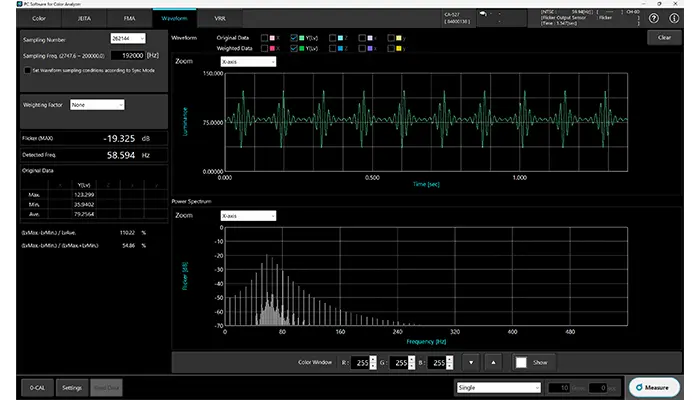
Waveform measurement is most useful when it can be done easily as part of a regular display evaluation process, especially when results need to remain consistent across different brightness levels and refresh modes. Konica Minolta supports this workflow by pairing its CA-500 series Display Color Analyzer probes with CA-S40 PC Software, bringing waveform capture, visualization, and reporting into a single measurement environment. With this setup, users can capture high-speed luminance waveforms along with time-resolved chromaticity, view the waveforms directly for review, and export the raw time-series data and processed outputs such as CSV and PNG for engineering review or compliance testing.
The CA-500 series probes support waveform measurement with sampling frequencies of up to 200 kHz, enabling the capture of high-speed temporal emission behavior, PWM dimming pulses, and VRR-related timing artifacts in practical scenarios. The sampling frequency can be adjusted depending on the display under test, allowing measurements to be optimized for low-frequency flicker characterization or high-frequency modulation analysis while maintaining stable signal quality and repeatability across brightness levels and operating modes.
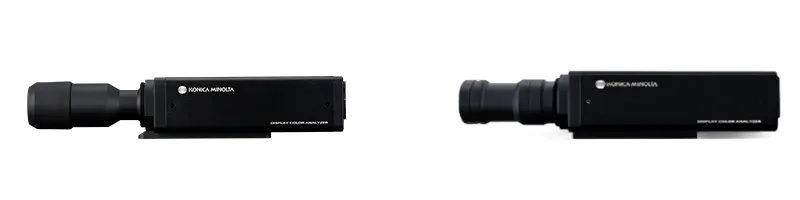
Display Color Analyzer CA-500 Series: CA-527 (left) and CA-510 (right)
The CA-500 series features two probe models to match different measurement needs: the Display Color Analyzer CA-527 with a Ø27 mm measurement area and the Display Color Analyzer CA-510 with a Ø10 mm measurement area. It makes it easier to select the appropriate probe for the display and test target, whether the measurement requires a broader area or a smaller, more focused region. Beyond practical measurement flexibility, both the CA-527 and CA-510 also support higher-speed measurement at low brightness, helping users capture more accurate waveforms as display technologies continue to evolve, including higher-contrast OLED designs and newer MicroLED systems that use dynamic drive methods.
Interested in applying waveform measurement to your display validation workflow? Book a practical demo to see how Konica Minolta CA probes and CA-S40 support flicker investigation, VRR testing, low-luminance stability evaluation, and time-domain emission characterization.