

How to Measure Psyllium Husk Color for Consistent Quality Control
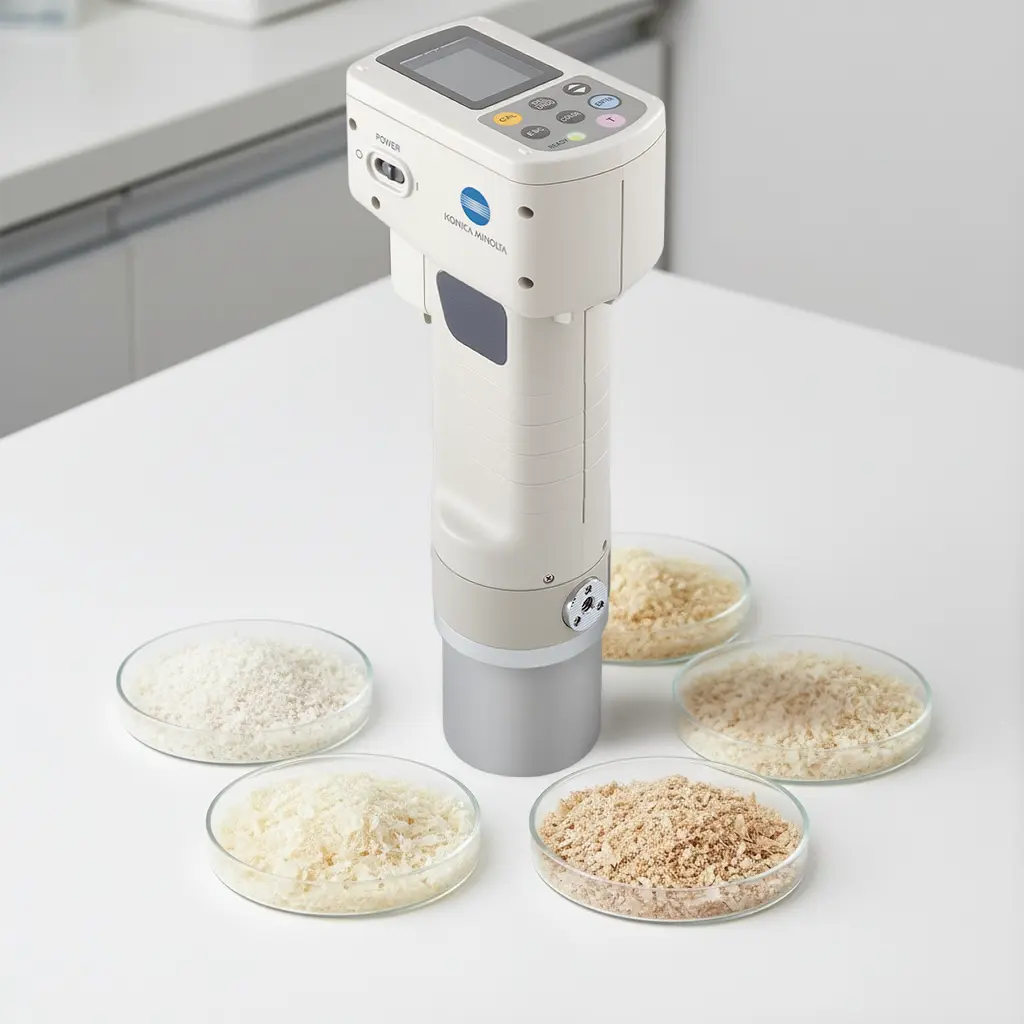
Psyllium husk is a high-value natural ingredient widely used in dietary supplements, pharmaceutical formulations, functional foods, and gluten-free products. Obtained from the outer coating of Plantago ovata seeds, it is valued for its high fiber content, water-holding capacity, and gel-forming properties.
For psyllium husk manufacturers, processors, and exporters, maintaining consistent product quality is essential. Buyers may evaluate factors such as purity, moisture, swelling capacity, particle size, cleanliness, and microbiological condition as part of incoming or finished-product quality evaluation.
Appearance is also important. Color is often one of the first characteristics noticed during incoming inspection or final product evaluation. A batch that appears darker, more yellow, or less uniform than previous deliveries may raise concerns, even when its functional performance remains within specification.
However, visual inspection alone may not provide the consistency required for reliable quality control. Objective color measurement helps manufacturers convert appearance into numerical data that can be compared across batches, production lines, and suppliers.
Why Psyllium Husk Color Can Vary
Psyllium husk is commonly supplied in different commercial purity levels and particle sizes. Its appearance may vary depending on the raw material, cleaning efficiency, separation process, milling conditions, storage environment, and the amount of seed fragments or other plant matter remaining in the sample.
Depending on the grade and product specification, psyllium husk may range from light cream or off-white to pale beige. Samples containing more visible dark seed particles or plant fragments may appear darker, duller, or more speckled.
Changes in raw material, processing, or storage conditions may also influence appearance. For example, a shift toward a more yellow or brown color may indicate that the material or process has changed and should be investigated. Color measurement cannot identify the exact cause of a quality issue by itself. It can, however, alert quality control personnel that a batch differs from the approved standard and requires further investigation.
The Limitations of Visual Inspection
Visual evaluation is simple and convenient, but it is also subjective. Different inspectors may describe the same psyllium husk sample differently, particularly when the color difference is small.
Results may be affected by:
- The type and intensity of the surrounding light
- The observer’s color perception
- The viewing angle and background
- Sample depth and packing density
- The distribution of darker particles within the sample
- Differences between work shifts or inspection locations
Psyllium husk is also naturally textured and nonuniform. One area of the sample may contain more light-colored husk, while another may contain darker seed fragments or fine powder.
As a result, visually checking only the top surface may not provide a representative assessment of the entire batch.
Objective Color Measurement with CIE L*a*b*
Instrumental color measurement provides numerical values that can be recorded, compared with an approved standard, and monitored over time. Instead of relying on descriptions such as “slightly darker” or “more yellow,” production and quality teams can communicate using measurable color data.
One of the most widely used color spaces for quality control is CIE L*a*b*. It describes color using three values:
- L* represents lightness, from black to white.
- a* represents the green-to-red axis.
- b* represents the blue-to-yellow axis.
For psyllium husk, the L* value can help monitor whether a sample is lighter or darker than the approved reference. Changes in a* and b* can indicate shifts along the green-to-red and blue-to-yellow axes.
The overall color difference between a production sample and an approved standard can also be expressed using ΔE*ab. This gives manufacturers a practical way to establish product-specific internal color targets and acceptance tolerances based on an approved reference.
In addition to CIE L*a*b*, other color parameters can provide useful supporting information when evaluating psyllium husk appearance.
The same CIELAB data can also be expressed as L*C*h, where:
- L* represents lightness.
- C* represents chroma.
- h represents hue angle.
L*C*h can make some color trends easier to interpret by separating changes in chroma from changes in hue. For example, when investigating a batch that appears darker, more yellow, or more brown than an approved reference, changes in L*, C*, and h can help describe how its appearance has shifted.
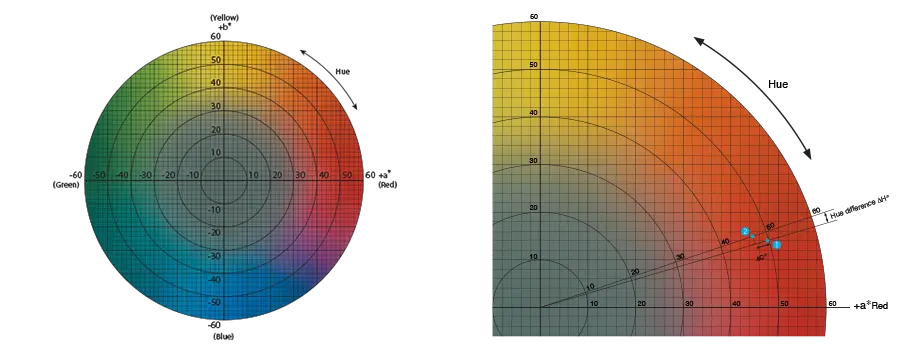
CIE a*b* and C*h color coordinates.
For psyllium husk grades where a lighter or whiter appearance is an important quality attribute, Whiteness Index (WI) may also be used as a supplementary parameter. WI provides a numerical indication of whiteness and can be useful for comparing batches that are expected to remain within a defined pale or off-white appearance range.
Supporting Process and Batch Consistency
Routine color measurement can help manufacturers identify variation at different stages of psyllium husk production.
During incoming inspection, measurements can be used to compare raw materials from different suppliers or harvesting periods. During cleaning and separation, color data may help indicate changes in the amount of darker seed fragments or other visible plant matter.
Measurements taken after milling can help production teams monitor whether process or equipment adjustments are influencing the product’s appearance. Finished batches can then be compared against an approved reference before packaging or shipment.
Color data can also support communication between processors, exporters, and customers. When all parties use the same measurement conditions and agreed reference standards, batch differences can be evaluated more consistently than visual descriptions alone.
How to Measure Psyllium Husk Color
Reliable color measurement begins with consistent sample preparation.
First, calibrate the instrument according to the manufacturer’s procedure using its designated white calibration plate. Keep the measurement conditions, including color settings, sample container, sample quantity, and preparation procedure, consistent for every batch.
Place a consistent quantity of psyllium husk into a suitable sample cell or container. Gently tap or level the material to produce a consistent measurement surface. Avoid applying different levels of compression between samples, as variations in packing density may influence the measured appearance.
The sample should completely cover the measurement area. When measuring through a transparent cell, ensure that the optical surface is clean and free from dust, fingerprints, or residue.
Because psyllium husk is naturally nonuniform, several readings should be taken from each sample. The material can be stirred and leveled again between measurements so that different portions of the sample are evaluated.
Averaging three to five readings can provide a more representative result than relying on a single measurement. For routine quality control, the number of measurements and the sample-preparation procedure should be established during method development and then applied consistently to every batch.
Measuring Psyllium Husk with the Chroma Meter CR-410
The Konica Minolta Chroma Meter CR-410 is designed for measuring large, textured, and uneven samples. Its Ø50 mm measurement area covers a larger portion of the sample, helping to obtain a more representative color measurement for nonuniform materials such as psyllium husk, powders, grains, and other granular samples.
The instrument can display results in CIE L*a*b*, L*C*h and other colorimetric data and indices, including Whiteness Index (WI). It also supports color-difference measurement, allowing a production batch to be compared directly with an approved standard.
When used with an appropriate sample cell or sample presentation method, the CR-410 provides a practical approach for evaluating psyllium husk color while reducing the subjectivity associated with visual inspection.
WATCH VIDEO
Chroma Meter CR-410 Video

Improve Psyllium Husk Quality Control with Objective Color Data
Color measurement does not replace other quality and safety tests, but it provides a fast and useful indicator of appearance and batch variation.
By establishing an approved reference, a consistent sample preparation method, and suitable color tolerances, psyllium husk manufacturers can improve grading consistency, detect process changes earlier, reduce subjective decisions, and provide customers with measurable quality data.
Looking for a reliable way to evaluate psyllium husk color? Contact Konica Minolta Sensing to discuss a suitable color measurement instrument and sample preparation method for your quality control process.