

Objective Hair Shine Evaluation with Spectrophotometer CM-36dG
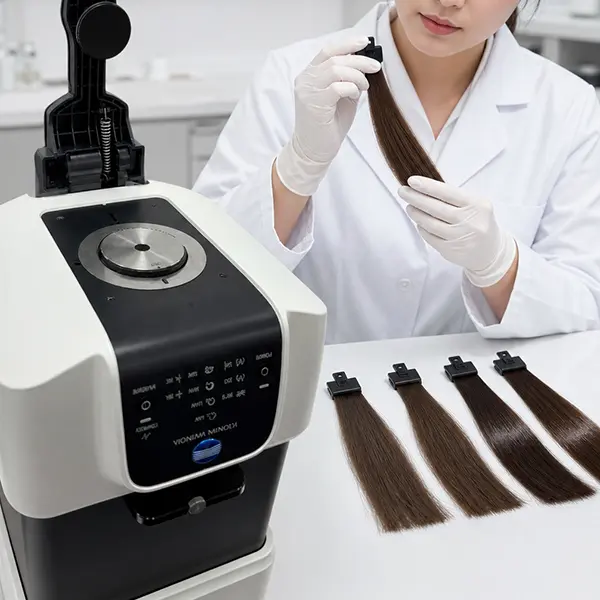
Hair shine is one of the most visible signs of healthy-looking hair. For shampoos, conditioners, treatments, and shine-enhancing products, gloss is more than a cosmetic effect. It is a product performance attribute that influences how consumers judge smoothness and overall hair condition.
In haircare product development, however, shine can be difficult to prove using visual inspection alone. Washed or treated hair may appear shinier than untreated hair, but visual evaluation can be affected by the observer, lighting condition, viewing angle, hair color, and sample handling. What looks glossy in one environment may appear less reflective in another.
This is where objective hair gloss measurement becomes important. Instead of relying only on visual judgment, manufacturers can use instrumental measurement to compare whether a shampoo, conditioner, or treatment produces a measurable change in hair shine.
Hair shine is closely linked to how light interacts with the hair fiber. The appearance of hair is influenced by factors such as surface reflection, light scattering, fiber alignment, cuticle condition, hair color, and the way individual strands are arranged within the tress. When hair fibers are more aligned and the surface condition is more uniform, light reflection appears more consistent. When fibers are misaligned, rough, or unevenly arranged, light scatters in different directions and the hair can appear duller.
Why Visual Hair Shine Evaluation Can Be Inconsistent
Visual assessment is useful as an initial observation, but it is not enough when R&D and quality control teams need reliable comparison data. The key question is not only whether hair looks shinier, but whether the difference can be measured consistently.
Hair is more complex than many common gloss measurement samples. It is not flat, rigid, or uniform. A hair tress is made up of many individual strands, and the bundle can shift slightly between measurements. Strand density, fiber direction, gaps between strands, curvature, and sample placement can all influence how light is reflected back to the measuring instrument.
This makes repeatability one of the most important parts of hair gloss testing. Without a controlled setup, the result may reflect sample handling variation rather than the actual effect of the shampoo, conditioner, or treatment. For haircare manufacturers, this creates a practical challenge: how to turn a visible difference in shine into reliable data that can support product development and quality control.
Instrumental gloss measurement helps turn a visible difference in hair shine into numerical data that can be compared more consistently. For haircare R&D, this makes it easier to evaluate whether a shampoo, conditioner, or treatment produces a measurable change in gloss. Because hair tresses are flexible and uneven, the measurement workflow must be controlled carefully. A consistent instrument setup and sample handling method are essential for producing reliable comparison data.
How the Konica Minolta CM-36dG Supports Hair Shine Measurement
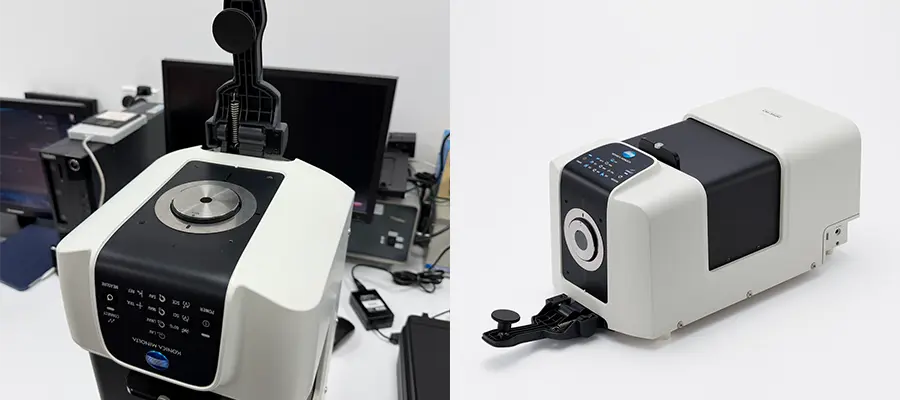
The Konica Minolta Spectrophotometer CM-36dG supports hair shine evaluation by allowing color and 60° gloss data to be measured in the same workflow. This helps R&D and quality control teams compare untreated, washed, conditioned, or treated hair samples without switching between separate color and gloss instruments.
The CM-36dG integrates 60° gloss measurement based on ISO 2813 geometry, allowing users to capture both color and gloss data together. For haircare evaluation, this supports controlled comparison between untreated and treated hair samples, provided the sample setup and handling method are kept consistent.
For hair gloss testing, untreated or unwashed hair can be used as the reference condition, while washed, conditioned, or treated hair can be measured as the test condition. The difference in gloss units helps indicate whether the product application produces a measurable change in shine.
Improving Hair Gloss Measurement Repeatability
Because hair tresses are flexible and uneven, repeatability depends strongly on how the sample is prepared and positioned. Strand movement, gaps between fibers, and inconsistent placement over the measurement aperture can all affect the gloss result. To reduce this variation, the hair bundle should be kept dense, stable, and measured in a consistent position each time.
For hair gloss evaluation using the CM-36dG, the following measurement workflow can be used:
- Perform a visual assessment of each hair sample before measurement to observe the relative glossiness. Washed or treated samples may appear shinier than unwashed samples.
- Position the CM-36dG in a vertical, top-port orientation so the measurement port faces upward. Place the hair sample flat on top of the port.
- Measure each sample near the thicker comb area, where the strand bundle is denser and can be positioned more consistently over the aperture.
- Use the unwashed hair sample as the standard or reference condition. Measure the washed or treated samples and record Gloss (GU) and Gloss Difference (dGU).
- Perform repeatability and reproducibility checks using the MAV Ø8 mm target mask to confirm that the measurement setup produces consistent results.
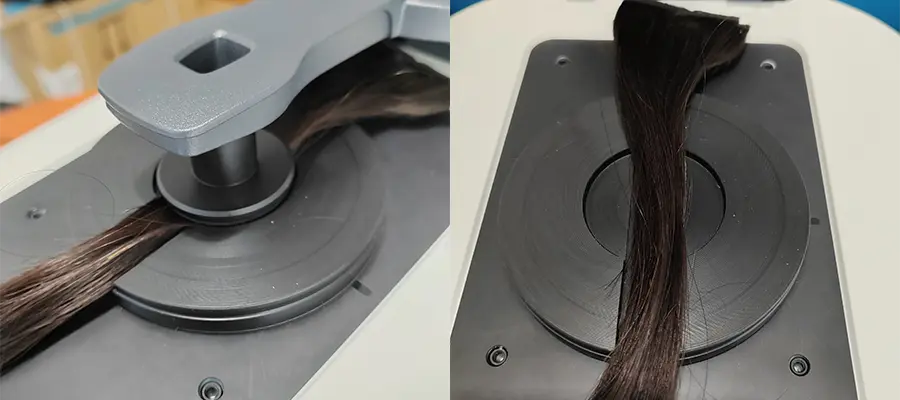
For better confidence, the same aperture, illuminant, observer setting, and sample placement method should be used across all samples. Multiple measurements can also be taken across the same tress or across replicate tresses, with results reported as an average where possible.
Objective Hair Gloss Testing for Shampoo and Conditioner Development
Objective gloss testing helps haircare manufacturers compare formulations, evaluate conditioner and treatment performance, and check consistency between product batches.
With color and 60° gloss measurement in one workflow, the Konica Minolta CM-36dG helps turn visible shine into measurable data for R&D, product development, and quality control.
Need a more objective way to measure hair gloss, or looking for the right measurement solution for your application? Contact us to arrange a free consultation with our experts.